Resiliance and Reform: Aligning US Priorities for the 2026 USMCA Review
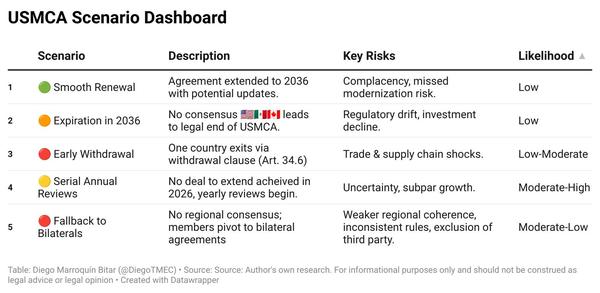
The following report evaluates and identifies key priorities for the scheduled July 1,
2026, review of the United States-Mexico-Canada Agreement (USMCA). In a moment of
heightened geopolitical and economic uncertainty, it is essential to protect and enhance the
United States’ trade capabilities and to reinforce North America as one of the most competitive
economic regions globally.
The upcoming review under Article 34.7 takes place amid declining trust, driven by U.S.
trade measures, Mexico’s judicial reforms, and the People’s Republic of China’s (PRC)
expanding influence across the continent. These dynamics complicate negotiations and risk
exploiting weaknesses in the current USMCA provisions. To this end, offices of the U.S.
Department of State (State) has requested an in-depth analysis of select sections of the USMCA
with actionable recommendations to strengthen U.S. economic policy during the upcoming
review.
This analysis focuses on four priority areas: critical minerals, agriculture, digital
trade, and counter-narcotics cooperation, highlighting their importance to North American
economic competitiveness and national security. An initial assessment of the current USMCA
reveals that these sectors are constrained by regulatory gaps, inconsistent enforcement, and
limited trilateral coordination. To address these weaknesses, the report’s recommendations
center on three overarching themes: strengthening trilateral cooperation, modernizing trade
provisions, and mitigating strategic vulnerabilities.
2026, review of the United States-Mexico-Canada Agreement (USMCA). In a moment of
heightened geopolitical and economic uncertainty, it is essential to protect and enhance the
United States’ trade capabilities and to reinforce North America as one of the most competitive
economic regions globally.
The upcoming review under Article 34.7 takes place amid declining trust, driven by U.S.
trade measures, Mexico’s judicial reforms, and the People’s Republic of China’s (PRC)
expanding influence across the continent. These dynamics complicate negotiations and risk
exploiting weaknesses in the current USMCA provisions. To this end, offices of the U.S.
Department of State (State) has requested an in-depth analysis of select sections of the USMCA
with actionable recommendations to strengthen U.S. economic policy during the upcoming
review.
This analysis focuses on four priority areas: critical minerals, agriculture, digital
trade, and counter-narcotics cooperation, highlighting their importance to North American
economic competitiveness and national security. An initial assessment of the current USMCA
reveals that these sectors are constrained by regulatory gaps, inconsistent enforcement, and
limited trilateral coordination. To address these weaknesses, the report’s recommendations
center on three overarching themes: strengthening trilateral cooperation, modernizing trade
provisions, and mitigating strategic vulnerabilities.